


Letters Patent Bench Cannot Interfere With Just Writ Orders: Supreme Court
 Copy Link
 Share
 Save
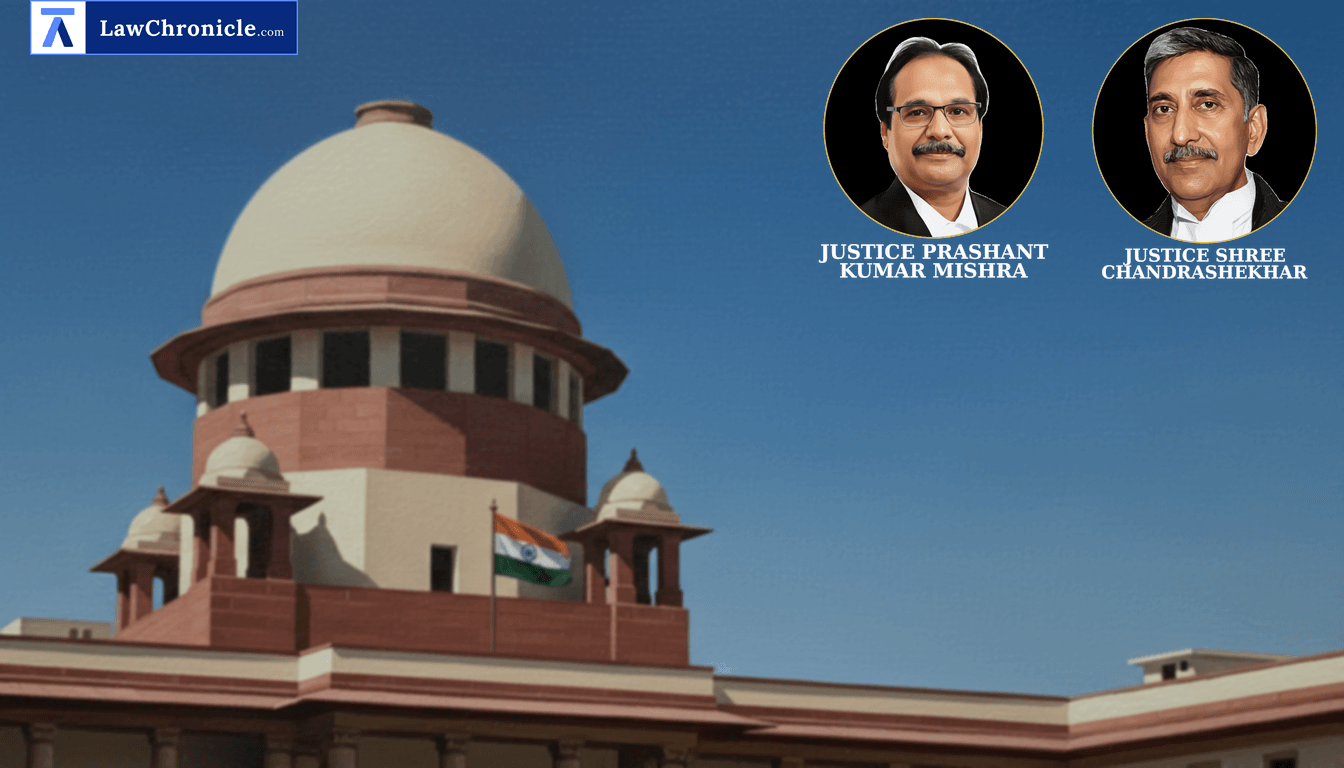
The Supreme Court has ruled that Letters Patent Benches cannot overturn writ court decisions merely because they hold a different view, stripping appellate benches of unrestricted powers to disturb reasonable single-judge orders. Reaffirming strict limits on intra-court appellate intervention, the Apex Court held that Division Benches sitting under Letters Patent jurisdiction must refrain from interfering with writ orders that promote equity and justice.
A Division Bench of Justice Prashant Kumar Mishra and Justice Shree Chandrashekhar delivered the judgment while hearing an appeal against a Madras High Court Division Bench decision. The High Court had reversed a writ court order that set aside the removal of an employee of Periyar University.
Key Takeaways
- Limits on Intra-Court Appeals: Letters Patent Benches cannot routinely disturb single-judge orders under Constitution of India, 1950 unless the findings are demonstrably erroneous on the face of the record.
- No Re-appreciation of Evidence: Division Benches cannot act as courts of departmental inquiry to re-evaluate evidence when the writ court properly identified a total absence of evidence.
- Protection Against Perverse Inquiries: Administrative punishments based on pure conjectures, surmises, or unproven assumptions violate principles of natural justice and warrant judicial interference.
- Exhaustion of Remedies Is Flexible: The availability of an alternate administrative appeal does not fetter the plenary writ jurisdiction under Constitution of India, 1950 when drastic penalties like removal from service are imposed without evidence.
Evaluating the scope of judicial review in domestic inquiry matters, the Supreme Court emphasized that findings in departmental proceedings must rest on concrete evidence rather than speculation. The Court set aside the Division Bench judgment and restored the writ court's order in favor of the appellant.
The Apex Court, in its reasoning, observed that "If the decision rendered by the writ Court in exercise of the powers under Article 226 of the Constitution is in furtherance of justice, equity and good conscience and is not against public policy then the Letters Patent Bench constituted under Clause 15 of the Letters Patent of Madras High Court or similar provisions of the Letters Patent of other High Courts cannot exercise its appellate jurisdiction under the Letters Patent to interfere with the writ Court’s decision. Simply put, the Letters Patent Bench can not interfere with the decision rendered by the writ Court which is otherwise just and reasonable."
Ratio
An appellate bench exercising jurisdiction under Clause 15 of the Letters Patent cannot interfere with a single judge's order passed under Constitution of India, 1950 of the Constitution of India, 1950 merely because it holds a different view; interference is permissible only when the writ court's decision is demonstrably erroneous, perverse, or contrary to public policy.
Background
The appellant, R. Saravanan, served as Deputy Registrar at Periyar University. Following allegations regarding disproportionate assets and granting of college affiliations, the University constituted a One-man Commission headed by a retired Judicial Officer to conduct an inquiry. Based on the inquiry report finding Charge Nos. 1, 4, and 10 proved, the University's Syndicate removed the appellant from service in July 2013.
The appellant challenged his removal in a writ petition under Constitution of India, 1950 of the Constitution of India, 1950. The single judge examined the record and set aside the penalty, relying on Bharat Iron Works v. Bhagubhai Balubhai Patel & Ors. ( "(1976) 1 SCC 518": 1975 CaseBase(SC) 65) and Rajinder Kumar Kindra v. Delhi Administration through Secretary (Labour) & Ors. ( "(1984) 4 SCC 635": 1984 CaseBase(SC) 296) to hold that the findings of the inquiry commission were perverse and based on no evidence. However, on an intra-court appeal filed by the University under Clause 15 of the Letters Patent of Madras High Court, the Division Bench re-appreciated the evidence, overturned the writ court's ruling, and restored the removal order.
While analyzing the legal framework, the Supreme Court traced the history of the Letters Patent and reviewed precedents including Hari Vishnu Kamath v. Ahmad Ishaque & Ors. ( "AIR (1955) SC 233": 1954 CaseBase(SC) 122), The Custodian of Evacuee v. Khan Saheb Abdul Shukoor, T.C. Basappa v. T. Nagappa ( "AIR (1954) SC 440": 1954 CaseBase(SC) 143), Syed Yakoob v. K. S. Radhakrishnan ( "AIR (1964) SC 477": 1963 CaseBase(SC) 79), Delhi Cloth and General Mills Company v. Ludh Budh Singh ( "(1972) 1 SCC 595": 1972 CaseBase(SC) 380), and Asha Devi v. Dukhi Sao & Anr. regarding certiorari jurisdiction. Citing Alapati Kasi Viswanatham v. A. Sivarama Krishnayya ( "CA No. 232 of 1961, decided on January 11, 1963": 1982 CaseBase(SC) 138) and Viveka Nand Sethi v. Chairman, J&K Bank Ltd. & Ors., the apex Court acknowledged that a Letters Patent Bench has the power to review questions of fact and law. However, it clarified that such appellate power is subject to self-restraint and cannot be used to disturb a fair and just order of a writ court based on mere conjectures.
Finding that the One-man Commission's findings were supported by no legal evidence, the Supreme Court allowed the appeal and set aside the judgment of the Division Bench.
Case Details:
Case No.: Civil Appeal No. of 2026 (Arising out of SLP (Civil) No. 4216 of 2020)
Neutral Citation: 2026 INSC 1136
Case Title: R. Saravanan v. Periyar University Rep by its Registrar & Ors.
Source: 2026 CaseBase(SC) 8272
Similar Articles


 Breaking News


