

Cut-Off Date For Open University Degree Invalidity Is Nov 20, 2017: SC
 Copy Link
 Share
Share Save
Save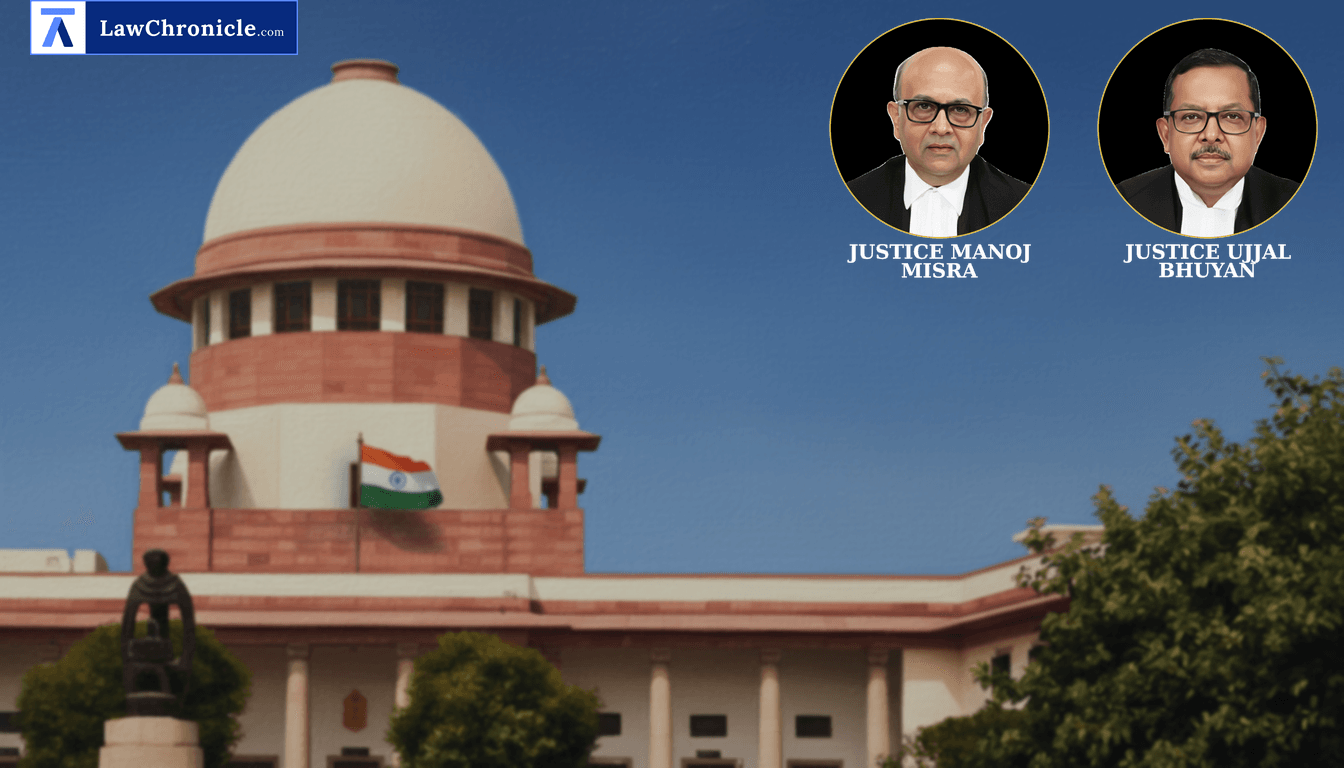
Protecting long-standing public servants from sudden retrospective shifts in educational eligibility rules, the Supreme Court has ruled that invalidation of open university foundation courses cannot be applied retroactively to undermine appointments and promotional avenues secured under past prevailing government orders.
A Bench comprising Justice Manoj Misra and Justice Ujjal Bhuyan heard the civil appeals challenging the judgment of the Madras High Court which had reversed a Single Judge's order and denied the appellant promotion to the post of Assistant Director of Tourism on the ground of lacking a regular 10+2+3 qualification.
Key Takeaways
No Retrospective Invalidation: Government orders revoking equivalence of open university foundation courses operate prospectively from November 20, 2017.
Protection of Vested Service Rights: Qualifications acquired under long-standing notifications cannot be invalidated decades later to deny promotions.
No Mandatory Regular Physical Stream: Distance education degrees obtained from recognized universities remain valid for public employment promotions unless specifically barred by rules.
Feeder Post Eligibility Finality: Authorities cannot reopen the validity of an employee's appointment to a feeder cadre after decades of unchallenged service to block further promotion.
Setting aside the High Court Division Bench and Review Bench orders, the Supreme Court held that the appellant possessed the requisite eligibility for promotion. The Court restored the Single Judge's order and issued clear instructions.
The Court has following directions:
"We accordingly hold that the appellant has the eligibility to be considered for promotion to the post of Assistant Director of Tourism. His case shall now be considered for promotion in accordance with law."
The Court, in its reasoning, observed:
"A candidate who has obtained the requisite qualification based on the prevailing norms i.e. GO Ms No. 528 dated 18.05.1985 which continued to remain in force for more than 24 years and finally came to be reversed after 32 years cannot be made ineligible by resorting to the maze of Government orders. It needs no reiteration that interpretation of such Government orders which have the effect of modifying and amending previous Government orders has to be done in a reasonable manner to avoid unnecessary hardship to those who have no control over the subject matter."
Ratio
Government orders withdrawing the equivalence of foundation courses offered by open universities to the +2/higher secondary stream take prospective effect strictly from the date of explicit formal declaration (20.11.2017). Statutory eligibility provisions such as Explanation 1(b) to Section 25 of the Tamil Nadu Government Servants (Conditions Of Service) Act, 2016 do not invalidate degrees acquired prior to its enforcement in light of savings clauses protecting existing service members, nor do they restrict valid degree qualifications strictly to regular physical courses unless expressly mandated.
Background
The appellant entered service as a Junior Assistant on compassionate grounds in 1983 after completing 10th standard and 11th standard. With due official permission, he completed the second-year foundation course from Madurai Kamraj Open University in 1984, followed by a B.Com degree via distance mode in 1987, alongside postgraduate diplomas and an M.Com degree.
He was promoted to Receptionist Grade II in 1990 and subsequently as Tourist Officer in 2011, a post regularized with effect from 2011. When he sought promotion to Assistant Director of Tourism after six years of service, the authorities rejected his request on July 22, 2020, asserting he lacked a regular 10+2+3 degree.
A Single Judge of the High Court quashed the rejection, relying on G.O. Ms No. 180 dated 11.09.2000 and G.O. Ms No. 217 dated 08.09.2007. However, the Division Bench reversed this decision, holding that under G.O. Ms No. 107 dated 18.08.2009, he was ineligible even for the feeder post of Tourist Officer. A review application was subsequently dismissed by the High Court.
Reversing the Division Bench, the Supreme Court relied on the principles articulated in P. Mahendran Vs. State of Karnataka regarding prospective application of recruitment rules, Chandrakala Trivedi Vs. State of Rajasthan ( "(2012) 3 SCC 129": 2012 CaseBase(SC) 710) concerning reasonable flexibility in evaluating educational equivalence, and Annamalai University Vs. Secretary to the Government, Information and Tourism Department on UGC regulatory supremacy. The Bench specifically approved the Madras High Court decision in P. Thavam Vs. State of Tamil Nadu, holding that G.O. Ms No. 144 dated 20.11.2017 serves as the prospective cut-off date for invalidating foundation courses. The Supreme Court also noted the saving provisions under Section 54 of the Tamil Nadu Government Servants (Conditions Of Service) Act, 2016 read with Article 309 of the Constitution of India, 1950, alongside provisions of the University Grants Commission Act, 1956 and the Indira Gandhi National Open University Act, 1985.
Case Details:
Case No.: Civil Appeal Nos. of 2026 (Arising out of SLP (Civil) Nos. 23378-79 of 2025)
Neutral Citation: 2026 INSC 911
Case Title: R.J. Gajendra Kumar v. Government of Tamil Nadu and Anr.
Source: 2026 CaseBase(SC) 824
 Breaking News